

shape
shape

Community Health Nursing Lab

Community Health Nursing Lab

Community Health Nursing Lab

The Community Health Nursing Lab at Carmel College of Nursing serves as a dynamic premier training ground, bridging the gap between classroom theory and public health practice. Designed to simulate both rural and urban community setups, this laboratory equips future nursing professionals with the clinical competence, diagnostic precision, and cultural adaptability required to deliver healthcare at the grassroots level.

Through hands-on training, students transition from clinical learners into resourceful community health leaders capable of managing population health, designing awareness campaigns, and executing evidence-based interventions.

Key Features & Pedagogical Resources

  • Epidemiological Survey Reports & Data Analytics: The lab houses a repository of comprehensive community survey reports compiled by students. Training in data compilation allows students to analyze community health demographics, identify morbidity trends, map environmental hazards, and understand the socio-economic determinants of health within adopted communities.
  • Family Folders & Longitudinal Health Records: A core component of our curriculum is family-centered care. Students utilize specialized Family Folders to learn systematic data collection, health history documentation, and multi-generational health tracking. This trains them to formulate, implement, and evaluate customized family care plans.
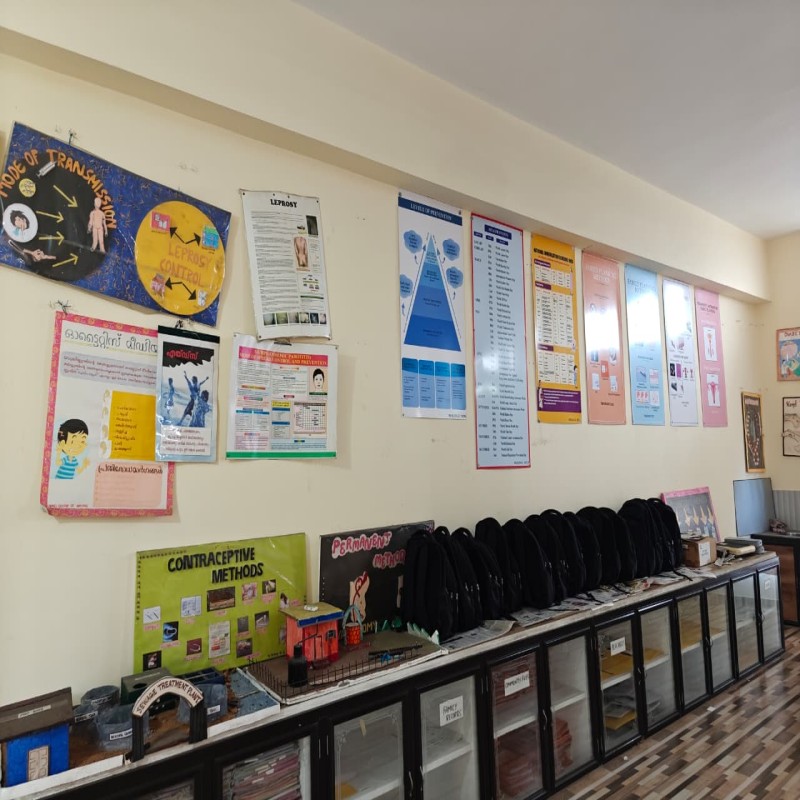
  • Fully Equipped Community Bags: Students master the art of "bag technique"—the cornerstone of home-health nursing. The lab features fully inventoried community nursing bags equipped with essential diagnostic instruments, dressing materials, and screening tools, ensuring students maintain strict aseptic techniques during home visits.
  • Advanced Simulators & Task Trainers: To ensure patient safety and student confidence before field deployment, the lab is equipped with clinical simulators and manikins. These are utilized to practice antenatal examinations, immunization protocols, newborn care, and family planning demonstrations.
  • Interactive Project Models & Audiovisual Aids: The laboratory is a vibrant hub of student-generated innovation, displaying three-dimensional working models, posters, and charts. These visual tools cover critical public health concepts including environmental sanitation, safe water purification systems, dietary-nutritional planning, and communicable disease control.
  • Health Education Tools: Students utilize various audio-visual aids and models to design and practice public health talks, street plays, and awareness campaigns, preparing them to be excellent educators in rural and urban settings.

Core Objectives & Learning Outcomes

  • Field Readiness: To instill critical thinking and adaptability, enabling students to deliver high-quality care in resource-limited settings.
  • Public Health Administration: To train students in maintaining meticulous health records, registers, and survey data according to national health standards.
  • Health Communication: To develop exemplary IEC (Information, Education, and Communication) skills, empowering students to conduct impactful health education, street plays, and awareness drives.

Lab Facilities at a Glance

Resource Category

Core Training Components

Skill Developed

Demographic Tools

Family Folders, Community Survey Files, Census Records

Community Diagnosis & Record Management

Field Equipment

Standardized Community Nursing Bags & Diagnostic Kits

Home-Visit Procedures & Aseptic Techniques

Simulation & Media

Maternal-Child Manikins, Audio-Visual Aids, Puppets

Health Education & Clinical Screenings

Exhibits & Projects

Water Purification, Sanitation, and Nutrition Models

Public Health Advocacy & Awareness

Our Objective: To foster an environment where students don't just learn nursing procedures, but master data-driven public health management and the art of resourceful, grassroots healthcare delivery